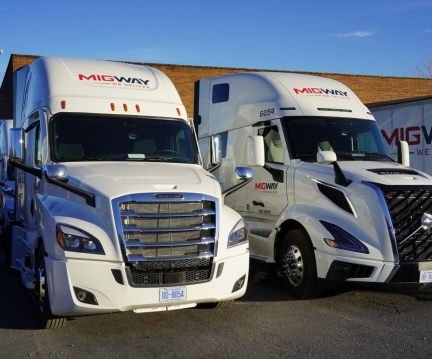
HVAC and Industrial Equipment Flatbed Shipping

HVAC and industrial equipment flatbed shipping is a high-cube, low-weight game with a rooftop deadline at the end of it. A packaged rooftop unit fills a 48 ft deck and weighs 8,000 lb, so the truck cubes out with room on the scale to spare. Then it has to land on a job where a crane is booked for a two hour window. MigWay is asset-based, runs 400 trucks and 750 trailers, and moves HVAC and industrial equipment across all 48 states with dispatch that plans to the crane, not around it.
Who This Serves
HVAC and industrial equipment moves between manufacturers, distributors, and mechanical contractors, and the delivery expectation tightens the closer it gets to the jobsite.
- HVAC equipment manufacturers shipping rooftop units, chillers, and air handlers to distribution and jobsites
- Mechanical and HVAC contractors taking equipment to a crane pick on a construction schedule
- HVAC and plumbing distributors restocking branch warehouses on repeat lanes
- Data center and mission-critical builders running CRAC units, chillers, and cooling towers on a tight commissioning schedule
- Industrial process equipment makers shipping compressors, pumps, tanks, and skids
- Generator and power equipment suppliers moving gensets and switchgear
- Boiler and heat exchanger manufacturers running heavy, tall units
- 3PLs and project logistics firms who need an asset-based carrier behind an equipment startup instead of a broker resale
What Ships on an HVAC Flatbed
Most of this freight is big and light. It takes up deck space and cube long before it approaches the scale, which flips the loading problem: the constraint is dimensions, not pounds.
- Packaged rooftop units (RTUs), large footprint, light for their size
- Air handling units (AHUs), often shipped in sections
- Chillers, air-cooled and water-cooled, heavy and tall
- Cooling towers, very high-cube, shipped assembled or in sections
- Condensing units and heat pumps, palletized or crated
- CRAC and CRAH units for data centers, shock-sensitive
- Boilers, dense and tall, more weight than a rooftop unit
- Industrial compressors and pumps, skid-mounted packages
- Heat exchangers and process tanks, long and high-cube
- Generator sets and switchgear, crated and shock-sensitive
- Ductwork and spiral pipe, extremely light and bulky
Equipment
MigWay runs 48 ft and 53 ft flatbeds and step decks. Straps, edge protection, dunnage, and tarps are standard on HVAC trucks, with chains available for the heavier chillers and boilers. Step decks give back roughly 18 to 20 inches of load height for tall units that break 8 ft 6 in on a standard deck. Trucks are governed at 70 mph. Drop trailer service is available for distributors that load on their own schedule.
Cube vs Weight and Deck Selection
The mistake shippers make on HVAC freight is quoting it by weight. A load can weigh 12,000 lb and still be a full truck because it filled the deck and the height envelope first.
Where the constraint sits
| Product | Typical Weight | Binding Constraint |
|---|---|---|
| Packaged rooftop unit | 3,000 to 12,000 lb | Deck length and footprint |
| Air-cooled chiller | 10,000 to 40,000 lb | Height and width, often permitted |
| Cooling tower | Light for size | Height and cube |
| Boiler | Heavy and dense | Weight and height |
| Ductwork and spiral | Very light | Cube, weighs almost nothing |
| Compressor skid | Moderate | Depends on skid size |
Deck height math
Legal height in most states is 13 ft 6 in. A standard flatbed leaves roughly 8 ft 6 in of cargo height. A step deck's lower deck leaves about 10 ft. Tall chillers, cooling towers, and stacked AHU sections often need the step deck to stay legal. As with any tall freight, the shipping height is the crated height, not the equipment nameplate height. A 9 ft unit on a 6 inch skid inside a crate is over 10 ft of cargo.
Weather Protection and Crating
HVAC equipment is full of coils, controls, and electronics that road spray and rain will ruin. This is where an HVAC load is won or lost, and it is the reason the commodity belongs on an experienced flatbed carrier rather than the cheapest available truck.
What gets tarped
- Uncrated rooftop and condensing units: exposed coils and control panels
- Air handlers with exposed openings: water inside an AHU is a warranty problem
- Anything with a nameplate the manufacturer wants legible on arrival
- Switchgear and electrical enclosures: moisture ingress is a reject at the gate
Crated freight
Much HVAC equipment ships in manufacturer crates or shrink wrap. A crate is not automatically weatherproof. Shrink wrap tears at highway speed and then funnels water into the unit instead of shedding it. MigWay drivers tarp over crated freight when the packaging will not survive the trip, and the decision gets made at the shipper, not discovered at delivery.
Shock-sensitive units
CRAC units, switchgear, and some chillers ship with impact or tilt indicators. The driver knows to note the indicator reading on pickup and again on delivery, so a tripped indicator has a clear point of origin instead of a dispute.
Tarping is included in the flat all-in rate. It is not a surcharge that appears after the unit delivers wet.
Securement for HVAC and Industrial Units
HVAC equipment falls under general cargo securement in FMCSA 49 CFR 393.100 through 393.114. Heavy units over 10,000 lb that are not vehicles still follow the general rules, but the practical challenge is different from steel or concrete: the freight is light, tall, and easy to crush.
Light and tall
A rooftop unit has a high center of gravity and thin sheet metal skin. Straps go over engineered points or the base rail, never crushing down on the cabinet. Over-tightening a strap on a light unit dents the panel and does nothing for securement. The unit needs enough tiedowns to stop movement, plus blocking against the light-load tendency to walk on the deck under braking.
Base rails and lift points
Most HVAC equipment has base rails or cast lift points. Securement goes through those, with edge protection where a strap crosses a sharp cabinet edge. Chains come out for the heavy chillers and boilers, where strap capacity is not enough.
Crated units
Crates get secured through the crate frame, not over the equipment inside. Dunnage keeps the crate off the deck and gives the straps a clean line. Corner protection goes on every crate corner a strap touches.
Re-checks
Drivers inspect securement within the first 50 miles and every 150 miles or 3 hours after that. Light freight settles and straps loosen, and a tall light unit is exactly the kind of load that shifts if the first check gets skipped.
Primary HVAC Lanes
MigWay runs HVAC and industrial equipment out of the manufacturing centers into construction and data center markets across the eastern half of the country.
| Origin | Destination | Route | Approx Miles |
|---|---|---|---|
| Charlotte, NC | Atlanta, GA | I-85 | 245 |
| Columbus, OH | Charlotte, NC | I-71 to I-77 | 430 |
| Nashville, TN | Richmond, VA | I-40 to I-81 to I-64 | 620 |
| Chicago, IL | Nashville, TN | I-65 to I-24 | 470 |
| Charlotte, NC | Northern Virginia data centers | I-85 to I-95 | 380 |
| Indianapolis, IN | Atlanta, GA | I-65 to I-24 to I-75 | 530 |
| Philadelphia, PA | Charlotte, NC | I-95 to I-85 | 540 |
| Louisville, KY | Columbus, OH | I-71 | 210 |
Transit Times
| Scenario | Typical Transit | Notes |
|---|---|---|
| Under 300 miles | Same day | Plant to jobsite inside one HOS clock |
| 300 to 600 miles | 1 day | Single driver, 12 to 24 hour standard lead time |
| 600 to 1,100 miles | 2 days | One reset stop, live tracking throughout |
| 1,100 to 1,800 miles | 3 days | Team option available on commissioning deadlines |
| Expedited HVAC | Truck in 4 hours | Failed unit or data center on a commissioning clock |
| Permitted oversize chiller | Add 1 to 2 days | Permit issue plus daylight-only travel windows |
Tarping a large uncrated unit adds 30 to 45 minutes at the shipper. That time is built into the numbers above.
Rate Structure
MigWay rates are flat and all-in. Fuel and all standard charges are included. One number up front, no add-ons. Tarping is in the number.
| Origin | Destination | Rate | Flat All-In |
|---|---|---|---|
| North Carolina | Maryland, Virginia, West Virginia, South Carolina, DC | $4.50/mi | $1,500 |
| North Carolina | Ohio, Indiana, Kentucky, Michigan | $3.00/mi | $1,700 |
| North Carolina | New York, Pennsylvania, Delaware | $3.75/mi | $1,850 |
| Ohio, Indiana, Kentucky, Michigan | Maryland, Virginia, the Carolinas, West Virginia, DC | $4.00/mi | $2,000 |
| Ohio, Indiana, Kentucky, Michigan | Alabama, Georgia, Tennessee, Mississippi | $4.00/mi | $2,000 |
| Pennsylvania, New York, Delaware | Maryland, Virginia, the Carolinas, West Virginia, DC | $3.00/mi | $1,600 |
| Illinois, Missouri, Nebraska, Kansas | Indiana, Ohio, Kentucky, Michigan | $3.50/mi | $1,900 |
| Same-state and same-region moves | - | - | $1,500 |
Permits and escorts on oversize chillers and towers are quoted into the flat number before the load books. Any load delivering into Florida is $5.00 per mile, all-in.
Rooftop and Jobsite Delivery
HVAC equipment usually delivers to a jobsite and goes straight up in the air. The crane is the appointment, and a missed window can push a rooftop pick to the next available crane day.
- What picks it? Rooftop units and chillers go up by crane. A flatbed does not self-unload, and rooftop equipment is not a forklift job.
- When is the crane scheduled? The pick window is fixed. The truck plans backward from it, and a late truck can lose the crane for the day.
- Are there rated lift points or spreader bar requirements? Large units often need a spreader bar so the pick does not crush the cabinet. The rigging crew needs to know before the truck arrives.
- Can a 70 ft tractor-trailer get to the pick point? A crane needs the truck within reach, which on a tight urban site is its own problem.
- Is the ground rated for the crane and the loaded trailer?
- Are there overheads on the approach and over the pick? A crane working near power lines stops the job.
- Who signs, and are they on site in the window?
MigWay dispatch runs the crane window and site access on the intake call. Data center and commissioning deliveries get extra attention because the whole trade sequence downstream depends on the unit landing on time.
Operating Playbook
- Intake and scoping: crated dimensions, weight, tarp and crate condition, crane window, lift points, and site access go in on the first call. Standard lead time is 12 to 24 hours. Expedited puts a truck under the load in 4 hours.
- Deck and driver assignment: dispatch runs the height math and picks flatbed or step deck. HVAC goes to drivers who have tarped and strapped light, tall, crushable freight.
- Permits: if a chiller or tower is over dimension, permits pull before the truck arrives.
- Loading: driver secures through base rails or crate frame, sets blocking against light-load walk, adds edge protection, and tarps if the unit or packaging needs it. Impact indicators noted on pickup.
- In transit: ELD and GPS give live tracking on every load. Securement and tarp re-checks happen at 50 miles and every 150 miles after.
- Delivery: driver works to the crane window, confirms rigging and lift points, and notes impact indicators on the POD. POD comes back the same day.
One dispatcher owns the load end to end. Zero outsourcing means the person who booked the crane window is the person who answers when the pick moves up an hour.
Why MigWay for HVAC Freight
- Asset-based: 400 trucks and 750 trailers on the payroll, not a broker board
- Zero outsourcing: MigWay drivers on MigWay equipment, one accountable plan per load
- Flat all-in rates: fuel, standard charges, and tarping included
- 24/7 dispatch: live people, in-house, at any hour a crane is booked
- Live tracking: ELD and GPS on every load
- 48-state service out of Charlotte, NC, with terminals opening in Dayton, OH and Harrisburg, PA
- Drop trailer capable for distributors that load on their own schedule
- EDI capable for manufacturers running equipment on a routing guide
HVAC and industrial equipment flatbed shipping comes down to a dry unit and a truck that hits the crane window. Call +1-980-255-3200 or reach MigWay at 9349 China Grove Church Rd, Pineville, NC 28134 to price a lane.
Frequently Asked Questions
Does MigWay tarp HVAC equipment?
Yes, and tarping is included in the flat all-in rate rather than billed after delivery. Uncrated rooftop units, condensing units, air handlers with exposed openings, and electrical enclosures all get tarped. Crated equipment gets tarped too when the crate or shrink wrap will not survive highway spray and rain.
Why is HVAC freight priced by size instead of weight?
Most HVAC equipment is high-cube and light, so a load fills the deck and height envelope long before it approaches the 80,000 lb scale limit. A rooftop unit can fill a 48 ft deck at 8,000 lb. The binding constraint is dimensions, which is why a light load can still be a full truck.
Flatbed or step deck for a chiller?
Height decides. A standard flatbed leaves roughly 8 ft 6 in of legal cargo height, which covers most rooftop and condensing units. Tall air-cooled chillers, cooling towers, and stacked AHU sections usually need a step deck, which leaves about 10 ft. Remember the crated height, not the nameplate height.
How is a rooftop unit secured without crushing it?
Straps go through the base rails or engineered lift points, never crushing down on the sheet metal cabinet. Over-tightening a strap on a light unit dents the panel and does nothing for securement. The unit also gets blocking against the tendency of light freight to walk on the deck under braking.
Can you deliver to a rooftop crane pick?
Yes, and most HVAC equipment delivers that way. The crane window is the appointment, so the truck plans backward from it, and a flatbed does not self-unload since rooftop units are not a forklift job. MigWay dispatch confirms the crane schedule, rigging, lift points, and site access on the intake call.
Do you handle data center cooling equipment?
Yes. CRAC units, chillers, and cooling towers for data centers ship on a tight commissioning schedule and are often shock-sensitive. Drivers note impact or tilt indicators on pickup and delivery so a tripped indicator has a clear origin. Live tracking lets the commissioning team see the unit inbound.
What does HVAC flatbed shipping cost?
Rates run from $3.00 to $4.50 per mile depending on origin and destination, with flat all-in figures starting at $1,500 on short and same-region moves. Fuel, standard charges, and tarping are in the quoted number. Permits on oversize chillers and towers are priced in before the load books, and Florida deliveries run $5.00 per mile all-in.
Do you handle oversize chillers and cooling towers?
Yes. Large air-cooled chillers and cooling towers frequently go over legal width or height, so MigWay pulls state permits directly, typically inside 24 to 48 hours. Multi-state loads need a permit per state, each with its own daylight and weekend travel rules. Permit and escort cost is quoted into the flat rate.
How fast can MigWay get a truck for HVAC equipment?
Standard lead time is 12 to 24 hours. Expedited service puts a truck under the load in 4 hours when a unit has failed or a data center is on a commissioning clock. Dispatch is 24/7 and in-house, so the request does not wait for business hours.
What states does MigWay cover for HVAC flatbed?
MigWay offers 48-state service from its Charlotte, NC headquarters, with terminals opening in Dayton, OH and Harrisburg, PA. The heaviest HVAC volume runs the manufacturing centers into construction and data center markets across the eastern half of the country. Call +1-980-255-3200 to price a specific lane.
See also