Most Reliable Trucking Company in North Carolina

When freight doesn't show up on time, it doesn't just inconvenience your team — it stalls production lines, delays customer orders, and costs money. Finding a reliable trucking company in North Carolina means finding a carrier that treats your shipment the same way you do: like it matters.
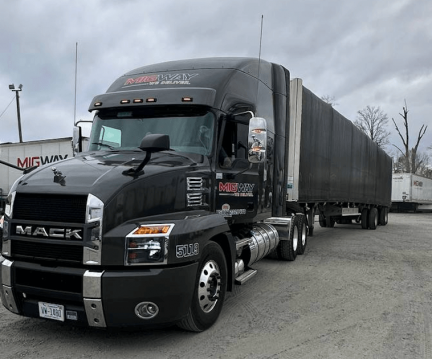
MigWay is an asset-based trucking company headquartered in Charlotte, NC. With a fleet of 400 trucks and 750 trailers, 24/7 in-house dispatch, and zero outsourcing, MigWay delivers freight across North Carolina and the East Coast with the consistency that shippers depend on.
How many trucking companies are in North Carolina?
North Carolina has about 47,100 trucking companies, according to the North Carolina Trucking Association. The industry supports 271,300 jobs, roughly 1 in 15 jobs in the state. In 2024, the state counted 64,610 heavy and tractor-trailer truck driver jobs. Trucks move about 236,780 tons of freight in the state every day.
That 47,100 number lumps together businesses that do different jobs. A search for trucking companies in NC returns asset carriers, LTL networks, freight brokers, and private fleets that never haul for outside customers. Each one fits a different kind of shipment.
| Type of NC trucking company | What it does | Best fit for |
|---|---|---|
| Asset-based truckload carrier | Owns its trucks and trailers, employs its drivers, hauls full loads | Full truckloads, recurring lanes, freight that can't miss a window |
| LTL carrier | Combines partial shipments from many shippers through terminals | 1-6 pallets, shipments too small for a full trailer |
| Freight broker | Finds a third-party carrier for your load and takes a margin | One-off loads, odd lanes, equipment you rarely need |
| Dedicated contract carrier | Assigns trucks and drivers to one shipper's freight on a set schedule | Steady weekly volume on the same lanes |
| Private fleet | A manufacturer or retailer running its own trucks | Not available to outside shippers |
Well-known North Carolina trucking companies by type
Some of the best trucking companies in North Carolina are household names. They just do different jobs:
| Company | Headquarters | Type |
|---|---|---|
| Old Dominion Freight Line | Thomasville, NC | LTL carrier |
| Epes Transport System | Greensboro, NC | Truckload carrier |
| Cargo Transporters | Claremont, NC | Truckload carrier |
| RXO | Charlotte, NC | Freight brokerage and managed transportation |
| MigWay | Pineville, NC (Charlotte metro) | Asset-based dry van and flatbed truckload carrier |
When you compare trucking companies in NC for full truckloads, line up asset carriers against each other first. Comparing an asset carrier's rate with a broker's rate is comparing two different products. For a longer list of Charlotte-area options, see our breakdown of the top logistics and transportation companies in Charlotte.
What Makes a Trucking Company Truly Reliable?
Not every carrier that calls itself reliable actually is. When evaluating trucking companies in North Carolina, shippers should look beyond marketing claims and focus on measurable factors:
- On-time delivery rate — Industry average is around 85–90%. Look for carriers consistently above that.
- Asset-based vs. broker-based — Asset carriers own their trucks and trailers. Brokers outsource. Asset-based means more control, fewer handoffs, less risk.
- In-house dispatch — 24/7 dispatch means someone is always monitoring your load, not leaving it to chance overnight.
- Live tracking — Real-time visibility lets you catch delays before they become problems.
- FMCSA safety record — A clean safety record is a direct indicator of how a carrier operates day-to-day.
- Driver retention — High driver turnover leads to inconsistent service. Stable driver teams know the routes, the equipment, and the expectations.
Reliability isn't a single metric — it's a system. Every component has to work together.
How can you find the safest trucking companies for your freight?
Pull the carrier's federal safety record before you book. Every interstate carrier has a USDOT number, and FMCSA publishes its inspection and crash history for free. A five-minute check covers most of it:
- Open the SAFER Company Snapshot. Search the USDOT or MC number at safer.fmcsa.dot.gov. Confirm the entity type says "Carrier" and the operating authority shows "Authorized for Property." A company listed only as a broker doesn't haul your freight itself.
- Check the safety rating. FMCSA ratings are Satisfactory, Conditional, or Unsatisfactory. Many active carriers have never been rated, so a blank field alone isn't a red flag. A Conditional or Unsatisfactory rating is.
- Compare out-of-service rates with the national average. As of September 25, 2026, the 24-month national averages are 22.26% for vehicles and 6.67% for drivers. A carrier below those numbers puts fewer trucks and drivers out of service at roadside inspections.
- Look at crashes against fleet size. Ten crashes means something different for a 20-truck fleet than for a 400-truck fleet.
- Check that the fleet size makes sense. Carriers update their MCS-150 filing every 24 months, so a fast-growing fleet can show an older truck count. A carrier quoting you 200 trucks while SAFER shows 5 is a different story.
- Verify insurance. FMCSA's Licensing and Insurance system shows whether liability coverage is on file. Ask for a certificate of insurance that names your company and lists cargo coverage.
One thing you won't see: since the 2015 FAST Act, FMCSA hides SMS percentiles and alerts for property carriers from public view. The underlying inspection and violation data is still public. FMCSA also plans to rename the seven BASIC categories "compliance categories," but the updated system has no launch date yet.
MigWay's record is public too. Look us up under USDOT 2328470 or MC 794884. MigWay holds a Satisfactory safety rating from FMCSA.
Red flags when vetting trucking companies in NC
- Operating authority listed as inactive, revoked, or "not authorized"
- Out-of-service rates well above the national average
- A brand-new MC number on a high-value load
- A "carrier" that can't tell you which driver and truck will pick up
- Contact details on the rate confirmation that don't match FMCSA records
Why MigWay Is North Carolina's Most Reliable Trucking Partner
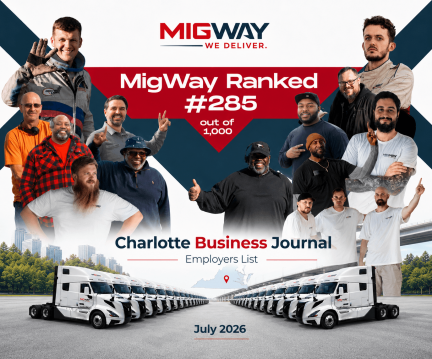
MigWay has been operating in North Carolina for over a decade. The company has made the Inc. 5000 list of America's fastest-growing companies five consecutive times — not by luck, but by building a reputation for freight that arrives on time, intact, and without surprises.
Asset-Based Fleet
MigWay owns every truck and trailer in its fleet. That means when you book a load with MigWay, a MigWay driver in a MigWay truck picks it up. There's no handoff to a third-party carrier, no broker margin, and no unknown variables introduced at the last minute.
This matters more than most shippers realize. When a broker-based carrier hits a problem, they're scrambling to find a replacement driver from a pool of unfamiliar owner-operators. When MigWay hits a problem, they solve it internally — with drivers and dispatchers who know the freight, the customer, and the route.
24/7 In-House Dispatch and Live Tracking
MigWay's dispatch team operates around the clock, every day of the year. Live tracking is included on every load — not as a premium add-on, but as a standard part of the service. You know where your freight is at any point in transit, and if anything changes, your dispatcher contacts you proactively.
This level of visibility is standard in theory, but rare in practice. Many carriers offer tracking through third-party portals with 30–60 minute update delays. MigWay's in-house system updates in real time.
Next-Day Service to 80% of the East Coast
From Charlotte, MigWay can reach 80% of the East Coast in a single business day. For North Carolina shippers moving freight to Virginia, South Carolina, Georgia, Tennessee, or the Mid-Atlantic, that transit time is a competitive advantage for your supply chain.
What should you look for when comparing dry van freight companies?
Compare dry van freight companies on who controls the truck, how the rate is built, and who answers when a load goes sideways. Price matters, but a cheap rate on a load that misses its appointment isn't cheap. These questions sort carriers fast:
| Question to ask | Good answer | Warning sign |
|---|---|---|
| Who owns the truck that picks up? | "Our truck, our driver" | "We'll find a partner carrier" |
| Is the rate all-in? | One number with fuel included | Linehaul plus a fuel surcharge that moves weekly |
| What trailer will show up? | 53' dry van, up to 26 standard pallets | "Whatever's available" |
| How do you track loads? | ELD and GPS location in real time | Driver check calls every few hours |
| Can you drop a trailer? | Yes, for regular lanes | Live load only |
| Who answers at 2 a.m.? | An in-house dispatcher | Voicemail or an after-hours call center |
| What's your on-time rate on my lanes? | A lane-level number from the last 90 days | A company-wide percentage with no detail |
The fuel question carries extra weight in 2026. DAT reported a record van fuel surcharge of 84 cents per mile in September 2026, with diesel averaging $6.29 a gallon. On a surcharge-based quote, that cost lands on your invoice after the load moves. MigWay quotes one all-in number, so you know the cost when you book.
Market context helps too. DAT put the national dry van contract rate at $3.24 per mile in September 2026, up 82 cents from a year earlier. Spot rates rose 96 cents over the same stretch to $3.01. When spot pays that much more than it did a year ago, carriers holding older contract rates tend to reject more tenders. An asset carrier with trucks committed to your lanes is less likely to walk away from the load.
See how MigWay runs dry van shipping in North Carolina, or get a number from the rate calculator.
MigWay's Services in North Carolina
MigWay offers a full range of freight services to North Carolina shippers:
| Service | Best For |
|---|---|
| Dry Van | General freight, packaged goods, palletized cargo |
| Flatbed | Oversized loads, steel, lumber, construction materials |
| Expedited | Time-critical shipments, hot loads, same-day and next-day needs |
| Intermodal | Cost-effective long-haul freight combining rail and truck |
| Drayage | Port and rail container moves across NC/SC |
| Final Mile | Last-leg delivery from warehouse to end destination |
North Carolina Freight Lanes MigWay Covers
MigWay's Charlotte base puts it at the center of the Southeast's freight network. Key lanes include:
- Charlotte to Raleigh / Durham / Research Triangle
- Charlotte to Greensboro / Winston-Salem / High Point (Triad)
- Charlotte to Wilmington (port access)
- Charlotte to Asheville (western NC)
- Statewide NC to Virginia, South Carolina, Georgia, Tennessee
- NC to the full East Coast corridor
What do North Carolina trucking rates look like in 2026?
MigWay's truckload rates out of North Carolina run $3.00 to $5.00 per mile in 2026, depending on the destination. Rates are all-in: fuel and all standard charges included. One number up front, no add-ons.
| Lane | Rate per mile (all-in) | Short-run flat rate |
|---|---|---|
| Within North Carolina | - | $1,500 |
| North Carolina to South Carolina, Virginia, Maryland, West Virginia, DC | $4.50 | $1,500 |
| North Carolina to New York, Pennsylvania, Delaware | $3.75 | $1,850 |
| North Carolina to Ohio, Indiana, Kentucky, Michigan | $3.00 | $1,700 |
| North Carolina to Connecticut, Massachusetts, New Jersey | $4.00 | - |
| North Carolina to Florida | $5.00 | - |
The flat rate applies when the mileage charge comes in lower. A Charlotte to Raleigh load stays inside North Carolina, so it bills at $1,500. A Charlotte to Columbus, Ohio load runs about 430 miles. At $3.00 per mile that's $1,290, so it bills at the $1,700 flat rate. Charlotte to Philadelphia runs about 540 miles, which comes to $2,025 at $3.75 per mile.
These rates cover legal-size dry van and flatbed loads. Oversize freight and lanes not listed here are quoted per load.
Which highways do North Carolina trucking companies run?
North Carolina trucking companies run on five main interstates: I-85, I-40, I-77, I-95, and I-26. Where a carrier sits on that grid shapes its transit times.
- I-85: Charlotte, Gastonia, Greensboro, High Point, Durham, and north into Virginia. The state's main manufacturing corridor.
- I-40: Wilmington to Raleigh, Greensboro, Winston-Salem, Hickory, and Asheville, then west into Tennessee.
- I-77: Charlotte north through Mooresville and Statesville into Virginia, south to Columbia, South Carolina.
- I-95: Eastern North Carolina through Lumberton, Fayetteville, Wilson, and Rocky Mount. The East Coast's main north-south freight route.
- I-26: Asheville south to Spartanburg and the Upstate, north into Tennessee.
Container freight moves through NC Ports' Port of Wilmington, the Port of Morehead City, and the Charlotte Inland Port. CSX runs the Carolina Connector intermodal terminal in Rocky Mount, on the I-95 corridor.
Charlotte, NC trucking companies and the I-85/I-77 crossing
Charlotte, NC trucking companies sit where I-85 and I-77 cross, with I-485 looping the city. Charlotte is also a rail hub for both Norfolk Southern and CSX. That lets a Charlotte carrier reach Atlanta, Richmond, and Columbia in one driver shift.
MigWay's headquarters is in Pineville, next to I-485 at the south edge of Charlotte. Trucks take the loop to I-77 and I-85 instead of cutting through downtown traffic.
What North Carolina Shippers Say Matters Most
Based on common feedback from logistics managers across NC industries, the top priorities when choosing a carrier are:
- Consistent on-time performance — not just a good average, but consistent delivery window reliability
- Direct communication — a real person to call, not an automated tracking portal
- No-excuse accountability — when something goes wrong, the carrier owns it and fixes it
- Carrier-owned equipment — reduces the risk of last-minute capacity issues
- Transparent pricing — no surprise fuel surcharges or accessorial fees buried in the invoice
MigWay is built around each of these expectations.
When does a dedicated carrier make sense for North Carolina shippers?
A dedicated carrier makes sense when you ship the same lanes every week and can predict the volume. Instead of tendering each load to the market, you get trucks set aside for your freight on a schedule.
Signs you've outgrown one-way spot and contract freight:
- You move 5 or more loads a week on the same few lanes
- Your dock runs tight appointment windows that new drivers keep missing
- Tender rejections spike every time the spot market heats up
- Your receivers have rules that take a driver a few visits to learn
- You run drop-and-hook on both ends and need trailers on site
The trade-off is commitment. Dedicated capacity costs you when volume drops, because the trucks are planned around your forecast. If your freight swings hard by season, a mix of dedicated and one-way freight usually works better.
MigWay sets up dedicated lanes for North Carolina shippers with regular volume. Trucks run out of Pineville with 24/7 dispatch and live tracking, the same as every other MigWay load. Call +1-980-255-3200 or request a quote with your weekly volume and lanes.
Which transportation and logistics companies in the US are best for reliable service?
The best transportation and logistics companies for reliable service are the ones with proven on-time numbers on your specific lanes. No independent body publishes a public on-time ranking for US carriers. On-time figures in marketing are self-reported, MigWay's included, so ask for lane-level data.
What are the best full truckload carriers for on-time delivery?
The US full truckload market splits into three groups:
- Large national asset carriers such as Knight-Swift, J.B. Hunt, Schneider, and Werner. Coast-to-coast coverage and big dedicated divisions. Smaller shippers can get less attention.
- Large brokers and 3PLs such as C.H. Robinson, RXO, and TQL. Deep carrier networks and easy coverage on odd lanes, but the truck belongs to someone else.
- Regional asset carriers such as MigWay. Dense coverage in one part of the country, direct access to dispatch, and the same carrier from pickup to delivery.
To test any of them, run a trial of 5 to 10 loads on one lane. Track pickup and delivery against the appointment, how often the carrier sends updates, and how it handles the first problem. Then compare the scorecards. A carrier's answer on load six tells you more than its sales deck.
Frequently Asked Questions
What areas of North Carolina does MigWay serve?
MigWay serves all of North Carolina, with particular strength in the Charlotte metro, Triad (Greensboro/Winston-Salem), Triangle (Raleigh/Durham), and eastern NC toward the Wilmington port corridor.
Does MigWay offer flatbed freight services in NC?
Yes. MigWay operates a dedicated flatbed fleet for oversized, heavy, and irregularly shaped freight across North Carolina and the broader Southeast.
How does MigWay handle time-critical shipments in North Carolina?
MigWay specializes in expedited freight — rush loads and hot shipments are a core part of the business, not an afterthought. 24/7 dispatch ensures a driver can be dispatched for urgent loads at any hour.
Is MigWay an asset-based carrier or a freight broker?
MigWay is fully asset-based. Every truck and trailer in service is company-owned. MigWay does not broker loads to third-party carriers.
How do I get a freight quote from MigWay?
Contact MigWay directly at migway.com or by phone. Provide your origin, destination, commodity, weight, and required delivery window for an accurate quote.
Does MigWay offer live shipment tracking?
Yes. Live tracking is included on all MigWay loads at no additional cost. You can monitor your shipment in real time through MigWay's tracking system.
What industries does MigWay serve in North Carolina?
MigWay serves manufacturing, retail distribution, construction, agriculture, and industrial sectors across NC, among others.
How long has MigWay been operating in North Carolina?
MigWay has been operating in North Carolina for over a decade, growing from a single truck to a fleet of 400+ trucks and 750+ trailers.
What is MigWay's safety record?
MigWay maintains full FMCSA compliance across all seven DOT safety categories. You can verify any carrier's safety record at safer.fmcsa.dot.gov.
Can MigWay handle drayage from the Port of Wilmington?
Yes. MigWay offers drayage services connecting ports and rail facilities across North and South Carolina to warehouses and distribution centers throughout the region.
Ready to Ship With North Carolina's Most Reliable Carrier?
If you're a North Carolina shipper looking for a carrier you can count on — one that owns its equipment, answers the phone at 2 a.m., and delivers on time — MigWay is ready to move your freight.
How many trucking companies are in North Carolina?
North Carolina has about 47,100 trucking companies, according to the North Carolina Trucking Association. That count includes asset carriers, LTL carriers, brokers, and private fleets. For full truckloads, compare asset-based carriers first.
Is MigWay a Charlotte, NC trucking company?
Yes. MigWay is headquartered at 9349 China Grove Church Rd in Pineville, NC, on the south edge of Charlotte in Mecklenburg County. It runs dry van and flatbed freight across the Charlotte metro and the rest of the state.
Does MigWay offer dedicated carrier service in North Carolina?
Yes. MigWay sets up dedicated lanes for North Carolina shippers with regular weekly volume. Dedicated loads get the same 24/7 dispatch and live tracking as every other MigWay load.
How much does it cost to ship a full truckload out of North Carolina in 2026?
MigWay's 2026 rates out of North Carolina run $3.00 to $5.00 per mile all-in, depending on the destination. Loads inside North Carolina bill at a $1,500 flat rate. Fuel and all standard charges are included in the number you're quoted.
See also