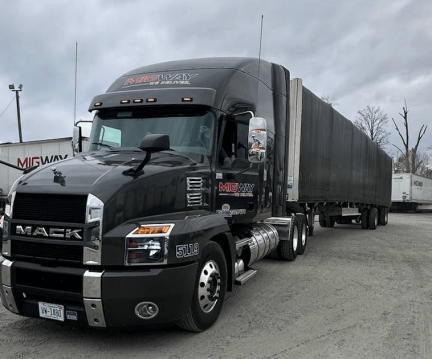
Flatbed Load Securement: A Complete Responsibilities Guide for CDL Drivers

Flatbed driving pays more than dry van for a reason. You're not just steering - you're responsible for making sure thousands of pounds of cargo stays exactly where you put it, from the moment you leave the dock to the moment you deliver. One loose strap or an overlooked edge protection requirement can mean a roadside out-of-service order, a CSA hit, or something far worse if freight ends up on the highway.
This guide covers everything you need to know about flatbed load securement responsibilities - the federal rules, the inspection schedule, the specific cargo categories that trip drivers up most, and how to protect your record and your paycheck. If you're running flatbed at MigWay or thinking about making the move, this is what the job actually looks like.
Who Is Legally Responsible for Your Load?
The answer is straightforward: you are. Under FMCSA regulations in 49 CFR Part 393, the driver holds legal responsibility for cargo securement once the truck moves. It doesn't matter whether dock workers loaded the freight, whether the shipper sealed the straps, or whether the dispatcher told you the load was fine. If it's on your trailer and you're behind the wheel, the load is yours to own.
That means before you pull away from any shipper, you need to walk the load yourself. Check every tie-down. Look at the blocking and bracing. Verify the count. If something doesn't meet federal standards, you have the right - and the responsibility - to fix it before you leave or refuse the load entirely. Inspectors don't care who loaded the freight. They care whether the driver accepted it and drove it down the road.
FMCSA Cargo Securement Basics: What the Numbers Actually Mean
Part 393 Subpart I lays out the minimum requirements for tie-down count, working load limits, and cargo-specific rules. Here's what you need to understand before you throw a single strap.
Tie-Down Count Requirements
The minimum number of tie-downs depends on the length and weight of the cargo:
- Cargo 5 feet or shorter AND 1,100 lbs or less: minimum 1 tie-down
- Cargo longer than 5 feet but shorter than 10 feet: minimum 2 tie-downs
- Cargo 10 feet or longer: 2 tie-downs for the first 10 feet, then 1 additional tie-down for each additional 10 feet of length
These are minimums. Depending on cargo weight, shape, and how the load sits on the deck, you'll often need more. When in doubt, add a strap. A citation for excessive securement doesn't exist.
Working Load Limit (WLL)
Every strap, chain, or binder has a working load limit printed on its tag. The combined WLL of all tie-downs on a single cargo unit must add up to at least 50% of the weight of that cargo. So if you're hauling a 30,000-lb steel coil, your tie-downs need a combined WLL of at least 15,000 lbs.
If a strap has a damaged hook, frayed webbing, or a missing tag, its WLL is zero for inspection purposes. Keep your tie-down equipment in good condition and pull anything that's worn or damaged before it ends up in an inspector's hand.
Aggregate Working Load Limit
When cargo is blocked, braced, or restrained from multiple directions, the calculation can get more complex - but the rule stays the same at its core. The forward restraint must handle half the cargo weight on its own, because a hard brake applies the most force in that direction.
Edge Protection: The Rule Many Drivers Ignore Until It Costs Them
Edge protection is required any time a tie-down would contact a sharp or rough edge that could cut, chafe, or wear through the webbing or reduce the chain's rated capacity. This includes I-beams, cut lumber edges, concrete blocks, heavy equipment frames, and most steel shapes.
Without proper edge protection, an inspector can argue that your tie-downs are compromised and may not be performing at their rated WLL. That means a violation even if your strap count and WLL numbers technically add up on paper. Use corner protectors, rubber sleeves, or purpose-made edge guards. It takes 30 seconds and it's not optional.
Your Inspection Schedule During the Trip
Securing the load at the shipper is only the beginning. FMCSA requires you to re-inspect at specific intervals throughout the trip:
- Within 50 miles of departure: Inspect the load after leaving the shipper, once everything has settled under movement. Straps loosen. Cargo shifts slightly. This first inspection catches those changes before they become dangerous.
- After every duty status change: Any time you log a change in your status, inspect the cargo before you continue driving.
- Every 3 hours or 150 miles: Whichever comes first, stop and walk the load.
- After any event that could affect securement: Hard stop, rough road, impact, or anything that could have shifted the load.
Log these inspections in your remarks or driver notes. An officer who asks when you last checked your load wants a real answer, not a shrug.
Cargo Categories With Special Rules
Part 393 Subpart I breaks out specific securement standards for cargo types that general rules don't fully cover. If you're hauling any of the following, the general tie-down minimums are a starting point - not the full requirement:
Logs
Logs require stakes, bunks, or bolsters to contain them laterally. You need at least one tie-down per 10 feet of load length, and the stakes must be strong enough to handle the lateral force of the full load weight.
Dressed Lumber and Building Materials
Bundles of lumber or similar materials need to be blocked and braced so individual pieces can't shift or slide free. Tie-downs must be placed over the top of each bundle, and the first and last tie-downs must be within 2 feet of the front and rear of the load.
Metal Coils
Steel coils are one of the most dangerous flatbed loads because of the way weight is concentrated and how they can roll. Coils loaded with the eye vertical need cradles or chocks to prevent rolling, plus direct tie-downs and header boards or blocking at the front. Eye-horizontal coils need similar blocking. The FMCSA rules for coils are detailed and specific - know them before you take the load.
Paper Rolls
Paper rolls have different rules depending on whether they're eye vertical, eye horizontal end-to-end, or eye horizontal side by side. Each configuration has its own minimum tie-down count and blocking requirements.
Heavy Equipment and Large Machinery
Equipment like excavators, skid steers, and bulldozers must be chocked, have all movable parts secured (boom arms pinned or blocked), and be tied down with chains rated for the weight involved. You also need to verify there's no fluid leakage that could affect the deck or the road surface.
Concrete Pipe
Pipe loaded in a single layer requires chocks or wedges, and tie-downs must prevent forward, rearward, and lateral movement. Nested pipe has its own separate set of rules covering the number of straps per tier.
What Roadside Inspectors Are Actually Looking For
DOT and state inspectors who conduct a Level III inspection (driver and cargo) will work through a checklist that includes:
- Tie-down count versus cargo length and weight
- Condition of all straps, chains, binders, and hooks
- Edge protection where required
- Evidence of cargo movement (scuff marks, shifted load, loose blocking)
- Correct placement of tie-downs (within 2 feet of front and rear for most loads)
- Tarpaulin condition if tarps are required (intact, properly secured, no holes that expose cargo)
- Blocking and bracing adequacy for the specific cargo type
An out-of-service order for cargo securement means you can't move until the violation is corrected on-site. That adds hours to your delivery time and generates CSA points that follow you and your carrier. The violations that generate the most OOS orders are damaged tie-downs, insufficient tie-down count, and shifted loads that are visibly at risk.
Tarping: Physical Work That Comes With Real Pay
Tarping is physically demanding and takes real skill to do correctly. A tarp that isn't secured properly can blow open at highway speed, exposing cargo to weather or debris damage - and potentially creating a hazard for other drivers behind you.
The basics of tarping correctly:
- Start at the front of the load and work toward the rear so wind doesn't get under the tarp as you pull it over
- Overlap multiple tarps by at least 6 inches in the direction the wind will push them (front edge over rear edge)
- Secure the front bungee or strap before moving to the sides, so the tarp doesn't slide off
- Check all side and rear tie-down points before driving - a tarp that's loose in one corner will work itself completely loose on the road
- Inspect the tarp after your first stop just like you inspect your straps
At MigWay, flatbed drivers receive tarp pay on top of the base rate of 60 CPM plus the 10 CPM performance bonus. Tarp pay is built into your compensation structure because the work is real and the skill takes time to develop.
Flatbed Pay at MigWay: What the Numbers Look Like
Running flatbed at MigWay puts you in a manual or automatic truck - your choice. The manual fleet runs 2018-2021 Freightliner Cascadias, Columbias, and Coronados with 10 and 13-speed transmissions. If you've spent years behind a manual and want to keep that skill sharp, this is one of the few carriers left where you can do it. The automatic fleet covers 2019-2026 equipment including Freightliner, Volvo, Mack, and Western Star.
All trucks are governed at 70 mph. Flatbed drivers average around $2,200 weekly, with the performance bonus on top of that applying to all miles - empty and loaded. You're not losing money running light. The coverage area runs East Coast, Northeast, and parts of the Midwest, so you're not chasing freight across distant territory to keep your miles up.
The flatbed rate is 5 CPM higher than dry van to reflect the extra work involved - pre-trip load inspection, mid-trip re-inspections, tarping, strap management, and the physical demands of working on a flatbed deck. It's a real premium for real skills.
Protecting Your CSA Score Through Load Securement
Every cargo securement violation generates points in the FMCSA's Cargo-Related BASIC category. These points stay on your record for 24 months and affect both your score and your carrier's score. Carriers with elevated BASIC scores get more inspections. More inspections mean more opportunities to find violations. It's a compounding problem that starts with one strap.
The violations that generate the most CSA points and the most out-of-service orders are also the most preventable: damaged tie-downs, wrong tie-down count, missing edge protection, and loads that have visibly shifted. All of these show up in a pre-trip walk-around if you're actually looking.
A few habits that keep your record clean:
- Replace damaged straps immediately - don't run them until the next terminal
- Keep a count of tie-downs before you start loading, not after
- Document your inspections in your logs with specific notes when something was adjusted
- Learn the specific rules for whatever cargo types you haul most frequently - general rules aren't enough for coils, pipe, or logs
- Never accept a load you can't secure to federal standards, even under pressure
MigWay Requirements to Run Flatbed
MigWay requires at least 2 years of recent OTR experience to drive with us. That requirement exists for good reason on flatbed - load securement isn't something you learn from a manual. It takes time behind the wheel, time walking loads at inspection stops, and time fixing problems in the field to understand how freight actually behaves in transit.
If you have that experience and you want to put it to work on a flatbed with real pay and trucks that are actually maintained, the application process is straightforward. MigWay is hiring for flatbed positions covering the East Coast, Northeast, and Midwest.
Frequently Asked Questions: Flatbed Load Securement
Who is responsible for load securement on a flatbed - the driver or the shipper?
Under FMCSA regulations (49 CFR Part 393), the driver is ultimately responsible for cargo securement once they accept the load. Even if dock workers or shippers loaded the freight, you are required to inspect it before moving and correct anything that doesn't meet federal standards. Shipper-loaded freight does not transfer legal responsibility away from the driver.
How many tie-downs are required on a flatbed load?
FMCSA rules require at least one tie-down for cargo 5 feet or shorter and weighing 1,100 lbs or less. Cargo longer than 5 feet requires a minimum of two tie-downs. For every additional 10 feet of length beyond the first 10 feet, you need one more tie-down. The working load limit of all tie-downs combined must equal at least half the weight of the cargo.
How often do you need to inspect your load during a trip?
FMCSA regulations require you to inspect cargo within the first 50 miles after loading. After that, you must re-inspect whenever you make a duty status change, after every 3 hours or 150 miles of driving (whichever comes first), and any time you stop for a break. If a strap or chain shifts or loosens during transit, you must stop and re-secure before continuing.
What is the minimum working load limit (WLL) for flatbed tie-downs?
The combined working load limit of all tie-downs securing a cargo unit must be at least 50% of the weight of that cargo. If you're hauling a 40,000-lb load, your tie-downs must have a combined WLL of at least 20,000 lbs. Always check the tag on each strap or chain - it lists the WLL clearly.
Do you get paid for tarping time on flatbed loads?
At MigWay, flatbed drivers receive separate tarp pay on top of their base rate of 60 CPM plus a 10 CPM performance bonus. Tarp pay compensates you for the time and physical effort involved in covering and securing loads - it's built into your pay structure, not something you have to negotiate load by load.
What cargo categories have special securement rules under FMCSA?
FMCSA Part 393 Subpart I lists specific rules for logs, dressed lumber, metal coils, paper rolls, concrete pipe, intermodal containers, automobiles, heavy vehicles, flattened or crushed vehicles, roll-on/roll-off equipment, and large boulders. Each category has its own minimum tie-down count, arrangement requirements, and blocking or bracing standards beyond the general rules.
Can you be placed out of service for a load securement violation?
Yes. Under CVSA out-of-service criteria, inspectors can place you out of service on the spot for violations like missing tie-downs, tie-downs with broken hooks or frayed webbing, cargo that shifted and is at risk of falling, or failure to have edge protection where required. These violations also generate CSA points that affect your safety score and your carrier's record.
What is edge protection and when is it required on a flatbed?
Edge protection is a corner guard, sleeve, or protective material placed between the tie-down and a sharp edge of the cargo. It's required any time a tie-down would contact a surface or edge that could cut, chafe, or wear through the webbing or chain. Common examples include metal plates, I-beams, concrete blocks, and lumber with rough-cut corners. Without edge protection, the working load limit of the tie-down is considered compromised.
What happens if your load shifts during a DOT inspection?
If an inspector finds that cargo has shifted, is improperly blocked, or is at risk of falling, you can be placed out of service until the load is re-secured to federal standards. The violation goes on your inspection report, generates CSA points for both you and your carrier, and can trigger additional scrutiny on future stops. In cases where cargo has already fallen from a vehicle, you may face fines and civil liability.
How does flatbed pay at MigWay compare to dry van?
MigWay flatbed drivers start at 60 CPM base versus 55 CPM for dry van, plus the same 10 CPM performance bonus applies to both. Flatbed drivers also receive tarp pay on top of that. Average weekly gross for flatbed runs around $2,200 before bonuses, compared to $2,100 for dry van. The extra pay reflects the additional skills and physical work that flatbed loads require.
See also