Dedicated Contract Carriage in 2026: How Midwest Shippers Can Lock In Capacity Before Spot Rates Spike Again

Spot rates climbed 16.5% year-over-year through Q1 2026 on key Midwest-Southeast corridors. At the same time, a March 2026 regulatory change restricting commercial driver eligibility for certain foreign visa categories pulled thousands of qualified CDL-A holders from the active driver pool - without headlines that matched the scale of the impact. If your freight program is still spot-heavy on lanes you run every single week, you are paying that volatility premium on purpose. Dedicated contract carriage exists to stop that.
What Is Dedicated Contract Carriage - and How Is It Different From Spot or Brokered FTL?
Dedicated contract carriage (DCC) is a formal, multi-load agreement between a shipper and an asset-based carrier. The carrier reserves specific capacity - trucks, drivers, and lanes - for your freight on a set schedule at a pre-negotiated rate. You get priority loading, consistent equipment, and a predictable cost per load. The carrier gets volume certainty.
Spot freight is the opposite model. You post a load, brokers bid, and whoever needs miles that day takes it. On a good week in a loose market, spot can beat contract rates. In a tight market - like the one shippers are navigating right now - spot pricing reflects real-time scarcity, and scarcity is expensive.
Brokered FTL sits in the middle. A broker matches your load to available carrier capacity, often at rates that float with the market and sometimes involve a third or fourth party handling the actual move. Service failures in brokered freight often trace back to exactly that distance from the asset.
Dedicated contract carriage removes the broker layer entirely. Your loads move on equipment you know, driven by drivers who run your lane regularly, dispatched by people accountable to your account. The operational difference is real - and in 2026, so is the cost difference.
Why 2026 Is the Wrong Year to Stay Spot-Heavy (Rate Data + Capacity Trends)
Two forces are colliding in 2026. First, spot rates on core Midwest-Southeast lanes have continued their upward trend from 2025, with Q1 2026 data showing a 16.5% year-over-year increase on lanes like Chicago-Nashville, Indianapolis-Atlanta, and Columbus-Dallas. Second, structural capacity is leaving the market faster than new drivers can replace it.
The March 2026 CDL eligibility change is the piece most logistics teams have not fully priced in. The rule tightened commercial driving authorizations for specific foreign visa categories, effectively removing a portion of the active driver pool that carriers in the South and Midwest had relied on heavily for OTR capacity. The headlines were small. The capacity impact was not.
The table below shows what has happened to spot rates on three benchmark Midwest-Southeast lanes versus what shippers with contract agreements are actually paying.
| Lane | Avg Spot Rate Q1 2024 | Avg Spot Rate Q1 2026 | Typical Contract Rate 2026 | Per-Load Savings at Contract |
|---|---|---|---|---|
| Chicago, IL → Nashville, TN | $1,850 | $2,160 | $1,900 | ~$260 |
| Indianapolis, IN → Atlanta, GA | $2,050 | $2,390 | $2,000 | ~$390 |
| Columbus, OH → Dallas, TX | $2,550 | $2,980 | $2,600 | ~$380 |
At 3 loads per week on a single lane, a $350 average per-load savings adds up to over $54,000 per year. That math gets more compelling as load frequency increases - and it gets more urgent as spot rates keep moving.
Werner and Schneider have both ramped up dedicated content marketing this year targeting exactly these shippers. The capacity competition is real. Carriers are signing dedicated agreements now, and available capacity on Midwest-Southeast lanes will tighten further through Q3 2026 as produce season draws regional equipment south.
The Core Benefits of Locking In Dedicated Capacity on Midwest-Southeast Lanes
For shippers running consistent volume on corridors like Illinois-to-Tennessee, Indiana-to-Georgia, or Ohio-to-Texas, the case for dedicated contract carriage is not abstract. It is operational.
- Rate certainty. Contract rates are fixed for the term of the agreement. Your landed cost per load does not change because a snowstorm in Kentucky pushed spot rates up 40% in a week.
- Capacity guarantee. Your loads move on your schedule. No competing for trucks with every other shipper in your region on a Monday morning.
- Consistent equipment. The same trailer spec shows up at your dock every time - no dimensional surprises, no equipment substitutions.
- Driver lane familiarity. Drivers who run your lane regularly know your dock procedures, your receiving hours, and your preferred routing. That reduces dwell and detention exposure significantly.
- Single point of accountability. One carrier, one contact, one data feed. No broker chain to untangle when something goes wrong.
- OTP consistency. On-time performance on dedicated programs typically runs higher than spot or brokered freight because the driver and equipment are assigned, not cobbled together at load time.
Midwest-Southeast lanes carry particular value for dedicated programs because they are directionally balanced - manufactured goods move south and southeast, return loads flow back north with finished goods and consumer products. A carrier with genuine asset density on these corridors can price dedicated programs competitively because the backhaul economics are solid.
How MigWay's Dedicated Program Works: Lanes, Equipment, and Commitments
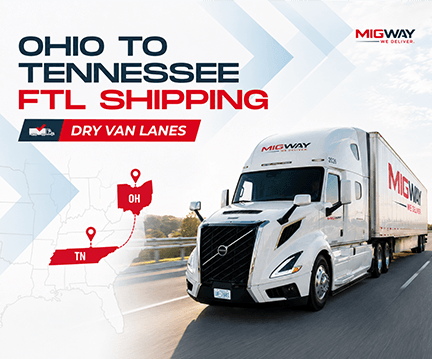
MigWay is an asset-based carrier operating 300 trucks and 500 trailers with primary coverage across the East Coast, Northeast, and Midwest. Dedicated contract carriage on Midwest-Southeast lanes sits at the core of that network - specifically on the Illinois/Indiana/Ohio corridor south to Tennessee, Georgia, and Texas.
All rates are flat and all-in. Fuel surcharge, standard accessorials, empty miles - one number, no add-ons. That is what is quoted and what is billed.
| Origin Region | Destination Region | Representative States | MigWay All-In Rate |
|---|---|---|---|
| Illinois / Missouri / Nebraska | Indiana / Ohio / Kentucky | IL, MO, NE → IN, OH, KY, MI | $3.50/mi, $1,900 flat |
| Illinois / Missouri | Texas / Arkansas / Louisiana | IL, MO → TX, AR, LA, OK | $4.00/mi, $1,900 flat |
| Ohio / Indiana / Kentucky | Tennessee / Georgia / Alabama | OH, IN, KY, MI → AL, GA, TN, MS | $4.00/mi, $2,000 flat |
| Ohio / Indiana / Kentucky | Texas / Arkansas | OH, IN, KY → TX, AR, LA, OK | $4.00/mi, $2,000 flat |
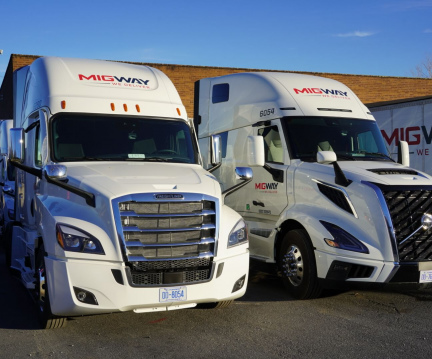
On the equipment side, MigWay operates both automatic and manual fleets. The automatic fleet runs 2019-2026 Freightliner Cascadia, Volvo, Mack, and Western Star units. The manual fleet is the last glider run ever built - 2018-2021 Freightliner Cascadia, Columbia, and Coronado models with 10 and 13-speed transmissions. All trucks are governed at 70 mph. All carry live ELD and GPS tracking, with 24/7 in-house dispatch - no outsourcing, no answering service.
Dedicated agreements require a minimum of 3 loads per week on a consistent lane. Volume commitments run on standard contract terms with rate locked for the agreement period. To request a dedicated lane quote, call +1-980-255-3200 or provide your origin, destination, and weekly volume - a rate comes back within 24 hours.
What to Look for in a Dedicated Carrier (and Red Flags to Avoid)
Not every carrier calling itself a dedicated provider is actually running an asset-based dedicated program. The distinction matters enormously when capacity gets tight and loads need to move.
When evaluating a dedicated trucking company in the Midwest, look for these specifics:
- Asset ownership, not asset-light brokerage. Ask directly: how many trucks and trailers do you own? A dedicated program built on brokered capacity is a contract-rate price tag on a spot-market service model.
- In-house dispatch. Outsourced dispatch means a third party handles your load when there is a problem. That is not accountability - it is a call-center buffer between you and your freight.
- Lane-specific density. A carrier with minimal presence on your actual corridor cannot deliver consistent transit times regardless of what the contract says. Ask where their trucks sit at night.
- Transparent rate structure. Fuel surcharge adders, accessorial schedules, and TONU charges can turn a competitive base rate into an expensive invoice. An all-in rate removes that math entirely.
- Driver retention data. High driver turnover is a direct predictor of service inconsistency on dedicated programs. Ask about annual driver turnover percentage.
Red flags: vague answers about asset count, references to "carrier network" rather than owned equipment, refusal to provide a flat all-in rate, and any dedicated proposal that does not include a lane-level capacity commitment in writing.
How to Evaluate Whether Dedicated Contract Carriage Is Right for Your Freight Volume
Dedicated contract carriage makes financial and operational sense for a specific type of shipper. It is not a fit for every freight program, and it would be a waste of your time to pretend otherwise.
Dedicated is the right model if your freight profile looks like this:
- You run 3 or more full truckload moves per week on the same lane or lane pair
- Your load pattern is consistent - same pickup windows, same delivery markets, predictable weekly volume
- You have experienced at least one significant service failure on spot or brokered freight in the past 12 months that cost you a customer relationship or production stoppage
- Your logistics team is spending time chasing trucks rather than managing the supply chain
- Your current freight cost per lane has become difficult to forecast for budget purposes
If your volume is irregular, your lanes change seasonally, or you ship fewer than 2-3 truckloads per week on any single corridor, spot or a managed routing guide may still be the better fit. The goal is matching the procurement model to the freight pattern - not signing a dedicated agreement to check a box.
For shippers who do fit the profile, the window to lock in 2026 contract rates is narrowing. Q3 capacity typically tightens across Midwest-Southeast lanes as agricultural volumes pick up and available equipment moves south. If you want a dedicated lane quote on IL/IN/OH to TN/GA/TX lanes, contact MigWay at +1-980-255-3200. Provide your origin, destination, and weekly load count - a rate is back within 24 hours.
Frequently Asked Questions
What is dedicated contract carriage in trucking?
Dedicated contract carriage is a formal agreement where an asset-based carrier reserves specific trucks, drivers, and lane capacity for a single shipper's consistent freight. Unlike spot or brokered FTL, the capacity is committed in advance at a fixed rate. Shippers with regular weekly loads on the same corridors use DCC to eliminate rate volatility and service inconsistency.
How is dedicated carriage different from a spot load?
A spot load is a one-time transaction where carriers bid on available capacity at current market rates. Dedicated carriage is a pre-committed capacity agreement at a negotiated rate. Spot can be cheaper in loose markets, but in tight markets like 2026, contract shippers pay significantly less per load and get guaranteed capacity when spot trucks are hard to find.
What volume do I need to qualify for a dedicated contract program?
Most asset-based carriers, including MigWay, require a minimum of 3 loads per week on a consistent lane before a dedicated agreement makes economic sense. Below that threshold, a well-managed routing guide with a preferred carrier list often provides better flexibility. The key variable is load pattern consistency, not just total volume.
Why are FTL contract rates better value in 2026 than spot?
Spot rates on key Midwest-Southeast lanes climbed 16.5% year-over-year through Q1 2026 as available capacity tightened. A March 2026 regulatory change affecting CDL eligibility for certain foreign visa categories removed additional drivers from the active pool, compressing supply further. Contract rates locked in before these shifts are running well below current spot market pricing on the same corridors.
What lanes does MigWay cover for dedicated freight?
MigWay's dedicated program is strongest on Midwest-Southeast corridors: Illinois, Indiana, and Ohio origins moving to Tennessee, Georgia, Alabama, and Texas. The carrier also runs East Coast lanes covering the Mid-Atlantic, Carolinas, and Northeast. Coverage spans dry van and flatbed, with 300 trucks and 500 trailers operating across those regions.
How are MigWay's dedicated contract rates structured?
MigWay rates are flat and all-in - fuel, standard charges, and all standard accessorials are included in one number. There are no fuel surcharge adders or accessorial schedules to negotiate separately. On IL/IN/OH to TN/GA/AL lanes, rates start at $4.00 per mile with a $2,000 flat on loads from Ohio, Indiana, or Kentucky into the Southeast.
What equipment does MigWay use on Midwest-Southeast dedicated lanes?
MigWay operates two fleets. The automatic fleet runs 2019-2026 Freightliner Cascadia, Volvo, Mack, and Western Star units. The manual fleet consists of 2018-2021 Freightliner Cascadia, Columbia, and Coronado models with 10 and 13-speed transmissions - the last glider trucks of that production run. All units are governed at 70 mph and carry live ELD and GPS tracking.
How quickly can MigWay provide a dedicated lane quote?
MigWay returns dedicated lane quotes within 24 hours. Call +1-980-255-3200 or reach out with your origin, destination, and weekly load count. The faster you can share freight details, the faster a rate comes back. There is no obligation attached to a rate request.
What are the red flags when evaluating a dedicated trucking company?
The biggest red flag is a carrier presenting a dedicated program that runs on brokered capacity rather than owned assets. Other warning signs include vague answers about actual truck and trailer count, outsourced dispatch, rates that separate fuel surcharges from the base, and dedicated proposals that do not include a written lane-specific capacity commitment.
How do I know if dedicated contract carriage is right for my freight program?
Dedicated carriage makes sense if you move 3 or more truckloads per week on a consistent lane, your volume is predictable week to week, and you have experienced spot market failures that cost you operationally in the past year. If your lanes change frequently or your volume is irregular, a routing guide with preferred carriers may be a better fit. The decision should be driven by your freight pattern, not by rate headlines alone.
See also